Managing customer orders involves more than processing a transaction. Sales teams handle order requests, warehouse teams coordinate fulfillment, finance teams manage invoices and payments, and customer service teams answer questions about deliveries, cancellations, and returns.
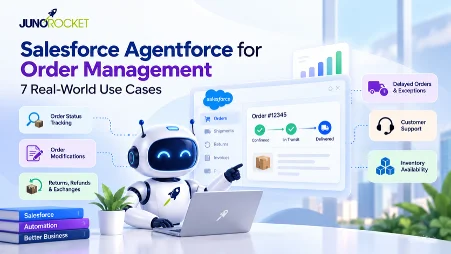
When these activities span disconnected systems, even a simple order inquiry can require multiple follow-ups and manual checks. This is where Salesforce Agentforce for Order Management can make a difference. By connecting AI agents with business data, configured actions, and existing workflows, businesses can automate repetitive tasks, retrieve relevant order information, and coordinate responses across teams.
Rather than replacing established order management processes, Salesforce Agentforce can help make them more responsive and efficient. In this blog, you will learn about seven practical use cases that show how businesses can apply AI to everyday order management challenges and accelerate their processes.
What Is Salesforce Agentforce for Order Management?
Salesforce Agentforce is Salesforce's platform for building AI agents that can understand requests, use available business context, and perform desired actions. In order management, these agents can support activities such as retrieving order details, checking delivery information, initiating return workflows, and escalating exceptions.
Unlike traditional workflow automation, which generally follows predefined triggers and rules, AI agents can interpret requests expressed in natural language and determine which configured actions are relevant.
For example, a customer asking why an order has not arrived may need a shipment-status check rather than a generic response. However, agents do not automatically have access to every enterprise system or permission to execute every transaction.
Effective Agentforce Order Management depends on reliable Salesforce Order Management records, appropriate integrations, defined business rules, and access controls. When these foundations are in place, AI can help coordinate processes while keeping sensitive actions within approved boundaries only.
7 Real-World Salesforce Agentforce Use Cases for Order Management
1. Automating Order Status Tracking and Customer Updates
Salesforce Agentforce for Order Management can retrieve order and shipment information from connected systems to answer tracking inquiries and support timely customer updates.
For example, when a customer asks about a delayed shipment, an agent can retrieve the latest available shipment status, explain the recorded delay using connected information, and initiate a customer notification or escalation when configured.
This Salesforce Order Management automation reduces repetitive tracking inquiries and improves order visibility, enhancing the process and eliminating unnecessary manual effort.
2. Handling Order Modifications and Cancellations
Address changes, quantity adjustments, and cancellations often depend on an order's processing stage. Agentforce Order Management can support Order Management Automation by checking eligibility and initiating authorized changes.
An agent can verify whether an order qualifies for modification, apply configured business rules, and initiate the appropriate workflow. If fulfillment has already started, it can explain the limitation or escalate the request.
This conveniently helps businesses process changes consistently without bypassing established policies.
3. Simplifying Returns, Refunds, and Exchanges
Returns require purchase verification, policy checks, and coordination with payment and fulfillment systems. Salesforce Order Management combined with Salesforce AI Automation can help simplify these activities.
An AI agent can verify order details and applicable return conditions, guide customers through return or exchange requests, and initiate an approved return workflow or route refunds for approval.
These actions depend on connected systems and configured permissions. Automating routine steps can reduce manual handling and give customers clearer guidance.
4. Improving Inventory Availability and Fulfillment Coordination
Inventory shortages can delay orders and complicate fulfillment. AI Agents for Order Management can retrieve stock information from connected systems and help identify alternative fulfillment options within Salesforce Order Management workflows.
For example, if an item is unavailable at one warehouse, an agent can check availability at another eligible location and present alternatives or updated delivery information.
This helps teams coordinate inventory and fulfillment decisions while following established allocation rules.
5. Managing Delayed Orders and Fulfillment Exceptions
Shipment delays, payment issues, and processing errors can disrupt fulfillment. Agentforce Order Management and Salesforce AI Automation can help identify exceptions and initiate configured alerts or escalation workflows.
When a shipment stops progressing, an agent can retrieve available status information and flag the delay, notify the responsible team or initiate an escalation, and prepare a customer update based on verified information.
This helps teams investigate problems earlier and coordinate corrective action more efficiently.
6. Automating Order-Related Customer Support
Routine questions about delivery dates, cancellations, returns, and order status can consume considerable support time. Salesforce Agentforce enables AI agents to respond using connected order records and approved knowledge sources.
For example, an agent can retrieve available delivery information and explain the current status. If a request involves a disputed charge or an issue beyond its permissions, it can transfer the case to human support with relevant context.
These AI Agents for Order Management support customer self-service while leaving complex decisions to employees.
7. Coordinating Order Workflows Across Multiple Business Systems
Order management often involves Salesforce CRM, ERP platforms, inventory applications, payment providers, and shipping systems. Agentic AI for Order Management can help coordinate multi-step activities through Order Management Automation.
For example, an agent can retrieve a sales order, request fulfillment information from a connected system, and initiate an authorized follow-up or customer notification.
APIs, Salesforce Flow, and other integration mechanisms connect these applications. Appropriate validation, permissions, and error handling help ensure that each step follows the intended business process.
For businesses that need to connect accounting and eCommerce systems with Salesforce, Juno Sync's Salesforce integration capabilities can help synchronize business data across QuickBooks, Shopify, and Magento.
Key Considerations for Implementing Salesforce Agentforce in Order Management
Successful implementation requires reliable processes alongside AI technology. Businesses should consider the following:
- Identify suitable use cases: Start with repetitive, clearly defined tasks before automating complex transactions.
- Connect reliable data: Keep order, inventory, shipment, and payment records accurate and accessible.
- Define permissions: Restrict agents to authorized actions and require human approval for sensitive transactions where necessary.
- Test workflows: Validate how agents handle missing records, conflicting information, and integration failures.
- Monitor performance: Review accuracy, escalation rates, workflow failures, and customer feedback.
These measures help businesses implement Salesforce Agentforce responsibly while maintaining security and operational control across Salesforce Order Management processes.
How Juno Rocket Supports Salesforce Order Management Automation
Connecting Salesforce Agentforce with Order Management Workflows
Juno Orders, Juno Rocket's Salesforce-native order management solution, connects quotations, sales orders, purchase orders, shipping, invoicing, and payment tracking within Salesforce.
For businesses exploring Salesforce Agentforce for Order Management, these connected workflows can provide a foundation for AI-assisted activities, including purchase order issuance, shipment tracking, and customer payment inquiries.
Such applications require the relevant integrations, permissions, and configuration. Juno Orders provides the underlying order management capabilities; separate Agentforce workflows must be designed and connected where the required functionality is not already available.
Explore Juno Orders, the Salesforce-native order management solution, to learn more.
Expected Business Benefits
Combining connected Salesforce Order Management with AI-assisted workflows can help businesses:
- Reduce repetitive tasks through automated information retrieval and follow-ups.
- Improve order visibility across sales, fulfillment, and finance.
- Support customer self-service with faster access to order information.
- Simplify transaction management across orders, shipments, invoices, and payments.
- Improve team coordination through connected business records.
Experience an efficient workflow by upgrading your systems with Juno Orders by JunoRocket for your business.
Conclusion: Improving Order Management with Salesforce Agentforce
Salesforce Agentforce for Order Management can help businesses improve order tracking, returns, fulfillment coordination, and customer support through AI-powered automation. However, successful implementation depends on accurate data, reliable integrations, clear permissions, and appropriate human oversight.
Explore Juno Rocket's Salesforce-native order management solution to streamline business workflows, connect order-related processes, and create opportunities for Agentforce-powered automation.
Juno Rocket Team
100% native Salesforce applications for order management, document generation, integrations, and SMS. More from Juno Rocket Team